-
(1st millennium BCE – 4th century CE)
At the end of the 1st millennium BCE, rapid socio-economic growth led to the emergence of the first state entities — Khorezm, Bactria, and Sogdiana. State structures carried out tasks such as defending agricultural oases from raids, constructing and maintaining irrigation systems, regulating land use, as well as organizing internal and external community relations.
The conquest campaigns of the Achaemenids (6th–4th centuries BCE), the invasion of Alexander the Great’s forces, and the rule of the Seleucids (4th–3rd centuries BCE) provoked powerful national liberation movements in Central Asia. Some episodes of this struggle for independence are vividly depicted in the artworks “The Revenge of Tomyris”, “The Feat of Shirok”, and “The Uprising of Spitamenes.”
From the 4th century BCE to the 4th century CE, the Khorezmian state flourished. This period witnessed a significant rise in all spheres of socio-economic and cultural life. Khorezm’s culture was distinguished by its uniqueness; trade and cultural ties were established with neighboring states, and Khorezmian writing emerged.
In the mid-3rd century BCE, the Greco-Bactrian Kingdom arose on the territory of Bactria and lasted for more than a hundred years. At the height of its power, it encompassed not only Bactria but also Sogdiana, Afghanistan, and northwestern India. During this time, cities and urban life flourished, and the process of cultural integration deepened significantly.
A special place in the history of Uzbekistan belongs to the state of Davan (4th–3rd centuries BCE), which covered the territory of the Ferghana Valley. At that time, more than 70 small and large cities existed there. The economy was based on agriculture and animal husbandry. Ferghana maintained close cultural and trade relations with China and Kangju.
Kangju (3rd century BCE – 4th century CE) was a powerful confederative state on the ancient territory of Uzbekistan. It united the lands along the middle reaches of the Syr Darya, Sogdiana, Khorezm, and the Aral regions.
In the 1st century CE, the unification of five Yuezhi tribes under the Kushan clan gave rise to the Kushan Kingdom, which played an enormous role in the history of Uzbek statehood. Under King Kanishka (2nd century CE), the Kushan state encompassed the southern regions of Central Asia, Afghanistan, India, and Eastern Turkestan, becoming one of the four great states of the ancient world. This period was marked by advances in all spheres of socio-political and economic life, as well as the intensive development of cultural integration. Urban construction also expanded. Archaeological finds from the site of Dalverzintepa provide vivid examples: bases and capitals of columns with alabaster acanthus leaves and volutes, wall paintings, sculptures, and a hoard of gold objects.
During this time, broad cultural and trade relations were established with Rome, China, and India. An important role in this process was played by the interregional trade route known as the “Great Silk Road.”
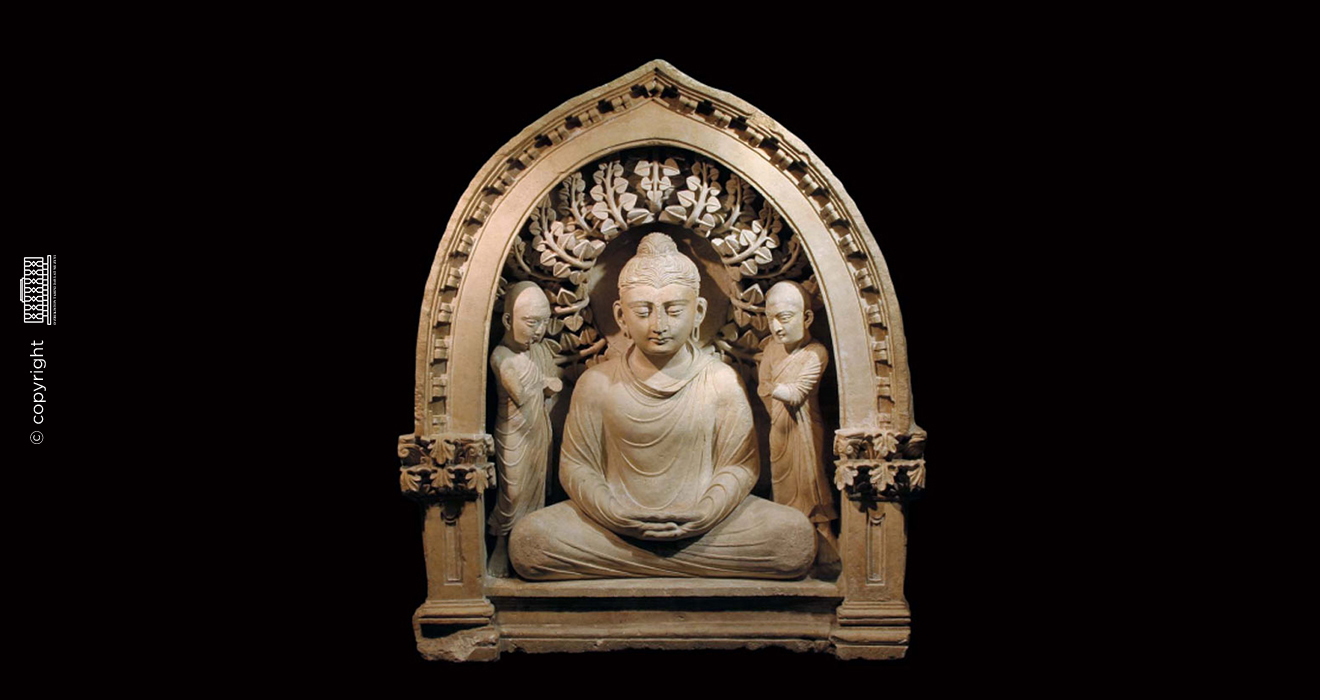
One of the most significant forms of cultural exchange between Central Asia and India was the spread of Buddhism. Old Termez became a major center of this religion. The museum halls today display materials from the Fayaztepa Buddhist temple, the Kara-Tepe Buddhist cultural complex, Airtam, and Zartepa. Exhibits include sculptures of the Buddha and Bodhisattvas, architectural décor in the form of friezes and wall paintings.