For some, he was an invincible Turanian ruler; for others, a great warrior and commander. Throughout history, everyone has given their own interpretation of Amir Temur. Yet none of those chroniclers ever wrote: “Temur was defeated.”
Known as a great commander in the history of Uzbekistan, Amir Temur was not only a powerful warrior but also one of the most outstanding military strategists of his time. His campaigns and victories were based on carefully planned tactics, innovative approaches, and a highly organized military system.
According to historical sources, the Sahibqiran did not suffer defeat in any major battle. This is explained by his military skill and his ability to make the right decisions on the battlefield. Advanced weaponry also played a significant role in his army. In particular, a flame-producing weapon known as “Ra’d” was considered innovative for its time.
The word “Raad” comes from Arabic and means “thunder.” This weapon not only inflicted physical damage on the enemy but also terrified them with a powerful explosive sound resembling thunder.
In the 14th century, stone-throwing machines were widely used in sieges, while fire-based artillery was only beginning to appear in Europe and had not yet become widespread. During this period, the Sahibqiran brought in Turkish engineers and, for the first time in Asia, used a fire-based weapon called Raad. Its construction is described in the poem “Saddi Iskandariy” by Alisher Navoi. It was made in the form of a spherical device filled with gunpowder and had two openings. One opening contained an oil-soaked fuse that was ignited. When the flame reached the gunpowder, it caused an explosion, resulting in damage far greater than that caused by ordinary stone projectiles.
The soldiers’ weapons and protective equipment were also carefully designed. Each weapon was optimized for maximum effectiveness in battle, while armor protected vital parts of the body without restricting movement.
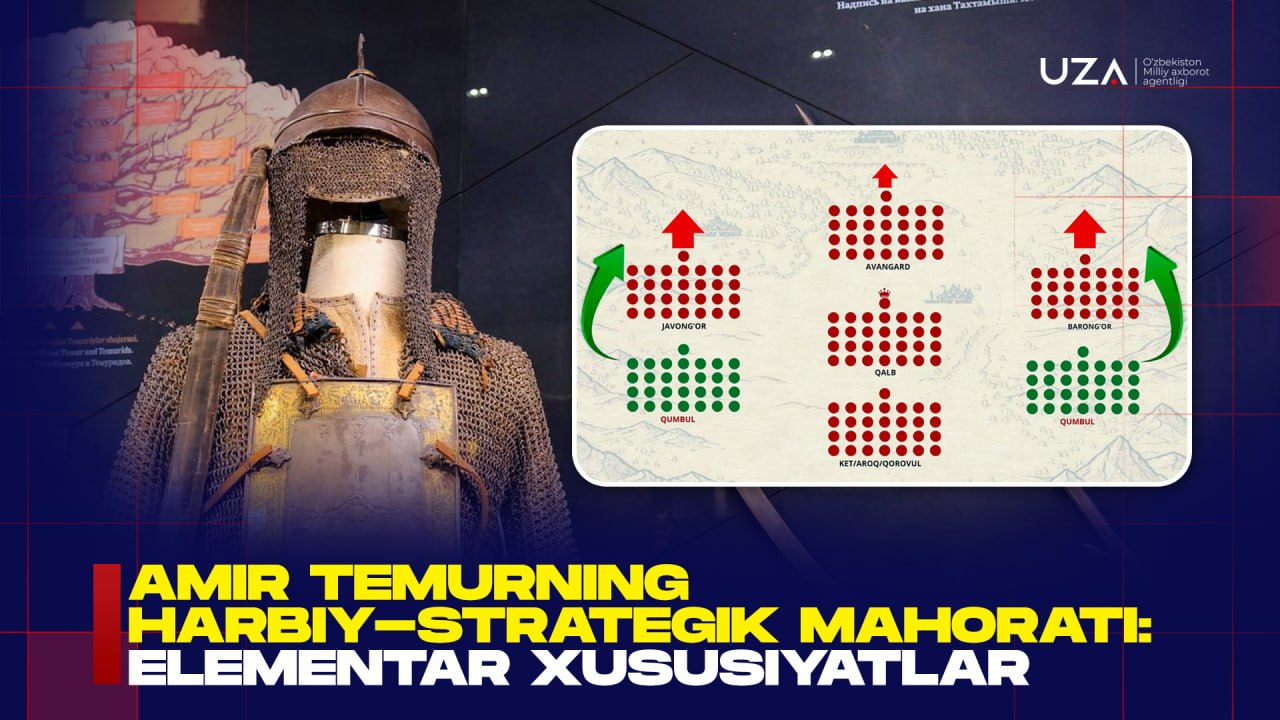
In terms of military strategy, Amir Temur improved existing combat methods. Alongside the traditional five-part army structure (vanguard, right wing, left wing, center, and reserve), he introduced additional specialized units. One such unit was the fast-moving cavalry group known as “Qumbul,” which played a decisive role by attacking the enemy from the rear with sudden strikes. When Amir Temur first used this tactic against Tokhtamysh, it caused panic among enemy troops, leading to their defeat and forcing Tokhtamysh to flee the battlefield.
Moreover, the Sahibqiran paid close attention to studying the battlefield in advance and considering factors such as the direction of sunlight. This demonstrates that he conducted battles not only through strength but also through deep analysis and strategic thinking.
Amir Temur paid great attention even to simple factors. Before each battle, he personally inspected the battlefield. He preferred wide and open areas, as narrow terrain could hinder large armies and reduce their defensive capabilities. He also chose locations near water sources to ensure that soldiers and horses did not suffer from thirst.
He strictly ordered his commanders not to engage in battle against the sun. Helmets, swords, and metal armor components were deliberately designed to reflect sunlight, creating discomfort and visual disadvantage for enemy troops.
Amir Temur was a commander who achieved victory not only through strength but also through intelligence, planning, and foresight. His military strategy is still studied in modern military education. Through his victories, he proved that every battle is not merely a clash, but the result of carefully calculated decisions. Therefore, he remains in history not only as a great warrior but also as a true strategist.